


Pull-ups are often crowned the most popular — and equally the most challenging — back exercise, whether you're aiming to build strength and power in your back, achieve the aesthetics of a well-defined V-taper, or a bit of both.
No matter if you’re a bodybuilder, functional fitness athlete, strength athlete, or just enjoy working out for health, your back is one of the most important pieces making up the puzzle that is you, and we can look to the pull-up bar to build it.
But what if you don't have a pull-up bar? What if you can't do pull-ups (yet)?
Here are pull-up alternative exercises you can implement either, instead of, or in addition to pull-ups.
Which Muscles are you Working Out When Doing Pull-ups?

To find the best alternative to pull-ups, let’s first understand what targets we’re aiming to hit.
- Lats: Your latissimus dorsi, commonly referred to as “the lats,” is your upper back’s main character. It takes up the majority of the back’s mass, responsible for the width of your body. It connects under your arm and ranges from your mid- to low back.
-
Traps: The lower portion of your trapezius, or “traps,” are the muscles running the center of your upper back, like columns on either side of your spine.
-
Biceps: Your biceps brachii, simply known as the biceps, the peaks, or “the gun show” (as many of us have come to affectionately call them) are the longer muscles of the upper arm responsible for pulling.
-
Rear Delts and Forearms: Pull-ups also use some secondary muscles, such as your rear delts, which pull your shoulders back, and the intricate muscles in your forearms, which are responsible for grip, pronation, and articulation of the wrist and hand. Forearms are the unsung heroes of pulling exercises, because if you can’t hang on to a bar, it’s difficult to work out with it.
Pull-ups can build your back in different ways, depending on where you place your hands on the bar. It’s a simple difference but important to understand. The narrower your hand placement during a pull-up, the more focus on the center of your back, working more of your lower traps and leading to a thicker build. The wider your hand placement, the more focus on the width of your back, working more of your lats.
Love the benefits but looking for pull-up alternatives? Here are seven variations to try instead of pull-ups.
1. Chin-Ups

Chin-ups are a great exercise to help in the development of pull-ups or to shift from your lats to a more biceps-focused exercise.
How to Do Chin-Ups:
- To do a chin-up, grab the bar underhand and pull yourself up until the bar is under your chin.
- Exhale on your way up.
- Throughout the motion, both up and down, squeeze your lats and lower traps, pinching your shoulder blades and flexing your biceps throughout.
- Chin-ups work both your back muscles and your biceps. Switching from the traditional wide grip of a pull-up puts more emphasis on your biceps.
Read More: 11 Different Pull-Up Hand Positions and the Muscle Groups They Target
2. Assisted Pull-Ups

Arguably, the simplest pull-up alternative is the assisted pull-up machine. This piece of equipment is monumental in helping people who can't achieve a full pull-up develop the strength in their backs and arms until they can.
By setting the appropriate counterweight on the assisted pull-up machine, you can customize how challenging each set is. Once the weight is selected, step or kneel on the weight assist, grab hold of the pull-up bar, and perform the exercise just as you would on a normal bar — this makes each assisted pull-up feel controlled and consistent.
If you don’t have access to an assisted pull-up machine, you can easily create your own version using pull-up bands (resistance bands) looped around a pull-up bar. Pull-up bands provide the assistance you need to build strength progressively and are a great pull-up alternative at home for setups without machines.
How to Do Assisted Pull-Ups with Bands:
- Loop a resistance band over the pull-up bar, making sure it's securely fastened.
Step one foot into the lower loop of the band, keeping your other foot free or resting on the band for additional stability.
- Grab the pull-up bar with both hands, palms facing forward (or in your preferred grip), and pull yourself up to perform an assisted pull-up, just as you would during a regular pull-up.
- The band will reduce some of the load by assisting you at the bottom of the movement, allowing you to work through the full range of motion while building strength. As you get stronger, you can switch to lighter bands for less assistance until you can perform unassisted pull-ups.
3. Seated Suspension Pull-Ups (TRX or Rings)
Suspension training is a fantastic way to progress your pull-ups. Here's one of my favorite variations. This gives you a pull-up alternative at home, too.
How to Do Seated Suspension Pull-Ups:
- Anchor a set of TRX Suspension Trainer ™ straps or Competition Gymnastic Straps and Wood Rings to an overhead anchor point, such as a pull-up bar or gym rack.
- With handles directly overhead, take a seat on the floor. The strap length should have the handles resting slightly above shoulder height. Grab hold and pull your shoulders back and down.
- Take a breath, brace your core, and pull yourself up off the floor. You can control the difficulty level by using your feet to provide support. Do your best not to rely on your legs for help and to keep the work in the upper body.
- Lower back down and repeat for the desired number of reps.
Pro tip: For the most advanced level of this movement, extend your legs out in front of you so you're sitting in an L position on the floor. When you lift into the pull-up, keep your legs extended, hovering just above the ground. This should provide extra core activation and tension on the upper body.
4. Australian Pull-Ups
This pull-up variation gets its name from doing pull-ups “down under” a bar. It’s also a solid alternative to pull-ups when you can’t yet perform full vertical pulls.
How to Do Australian Pull-Ups:
- Lie beneath a bar (you can use a barbell resting on pin-pipe safeties or gymnastics rings), keeping your feet on the ground.
- Pull your chest to the bar.
- Depending on how high you set the point of your hands, Australian pull-ups can work as a sliding scale between traditional pull-ups and rows. The higher the bar, the closer the exercise imitates pull-ups. The lower the bar, and the more level to the ground you remain, the more the exercise imitates rows.
- Once again, wider hands equal more lats, and a narrower grip equals more traps.
5. Lat Pulldowns
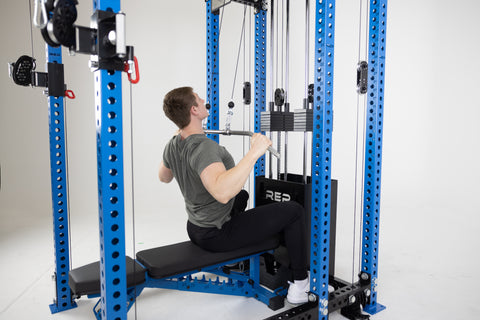
The lat pulldown is essentially the same movement as pull-ups, but with nuanced differences, such as lacking the stabilization from the weight of your entire body. They play a powerful role in developing the same muscles and movement while providing the option of weight below and above bodyweight.
Additionally, there are many variations, including close-grip cable lat pulldowns, wide-grip, narrow-grip, one-arm, and underhand. They’re a reliable pull-up alternative when you want precise loading.
How to Do Lat Pulldowns:
- Set the knee pad to a secure height to hold your body in place, then choose your weight.
- Grab the bar (wide for width, narrow for thickness).
- Pull the bar down to the top of your chest while squeezing your shoulder blades together.
- Exhale on the way down.
- Lastly, raise the bar to a full extension with control. That’s one rep!
By doing one-arm alternations, strength imbalances can be evened, and by doing underhand pulldowns, you mimic the benefits of a chin-up.
Read More: Is This the Single Best Attachment for a Power Rack?
6. Bent-Over Rows

Another popular back exercise, you can perform bent-over rows in multiple ways. Whether with barbells, dumbbells (simultaneous or alternating), an Open Trap Bar, or resistance bands, bent-over rows are a staple of building a strong, defined back. They're also a proven alternative to pull-ups when you want to load the back heavily without hanging.
The most important thing to remember during this exercise is to choose a weight that your spine can support. Whether going for one rep or many, don’t let your back bow. Maintain control of your posture and, therefore, your safety.
How to Do Bent-Over Barbell Rows:
- Bend over while maintaining a straight spine.
- Arch your hips back and bend your knees a little.
- Keep your weight in your heels rather than slipping forward into your toes.
- Take hold of your weight. While maintaining your straight back, pull the bar or band to your chest, making sure to squeeze your shoulder blades together at the top of the lift.
- Exhale on the way up.
- When lowering the weight, maintain control through the full extension.
- Wash, rinse, and repeat.
7. Seated Cable Rows

Seated cable rows are similar to bent-over rows but with less strain on your lower back and hips. To properly perform the exercise, repeat the form of a bent-over row from a seated position.
How to Do Seated Rows:
In addition to protecting your spine and not bowing your back:
- Don’t rock back and forth with the motion, but maintain control of your upright, seated position.
- Pull the bar toward your torso until it reaches your midsection or just below your chest, around the level of your sternum. The exact position can vary slightly depending on your individual anatomy and the grip you're using, but the goal is to squeeze your shoulder blades together as you pull, keeping your chest up and your back straight.
- Avoid pulling the bar too high toward your neck or too low toward your stomach, as this can shift focus away from your back muscles or strain your shoulders.
Read More: How to Do a Seated Cable Low Row
Takeaway
You don’t need a pull-up bar, or a single strict pull-up, to build a strong back. Assisted and banded pull-ups let you train the full movement with help. Suspension and Australian pull-ups work well at home. Lat pulldowns give you precise loading, and bent-over and seated cable rows let you go heavy without hanging from a bar.
Pick two or three that fit your equipment and strength level, then cut the assistance or add load as you progress. If a full pull-up is your goal, these alternatives can help you get there.
FAQs
Are pull-ups required for an effective back workout?
No. You can get a great back and biceps workout without pull-ups, because no single exercise makes or breaks a program. Pull-ups are highly effective, and so are the alternatives above. They work best together in a balanced plan, rotated based on your goals, equipment, and recovery.
What are the best alternatives to pull-ups?
The best alternatives to pull-ups include chin-ups, Australian pull-ups, lat pulldowns, bent-over rows, and seated cable rows. Each targets your lats, traps, and biceps in slightly different ways. Use a mix to build strength and muscle through multiple angles. Any solid pull-up alternative should let you progress load and range of motion.
What’s the best pull-up alternative at home?
The best pull-up alternative at home is band-assisted pull-ups using a sturdy pull-up bar and pull-up bands, or suspension pull-ups with a TRX Suspension Trainer™ or rings. Australian pull-ups under a bar and one-arm dumbbell rows also work well in small spaces. Rotate these as you gain strength and lower assistance over time.
How do I progress from assisted to unassisted pull-ups?
Gradually reduce assistance using bands or a machine, aiming for full range with control. Add slower negatives, pause reps at mid-range, and increase volume weekly. Mix in chin-ups and rows to build biceps and back strength, then test single, strict reps before adding sets.
This article was updated by Matt Gavin, NASM-CPT.
similar to this

Want Better Runs? Learn How to Improve Your Running Form
Find your stride.

How to Stay Fit as a Busy Parent
It ain't child's play.

NEWSLETTER SIGNUP
Product launch information, promotions, blogs, and REP news.
